
From Micro to Macro
Why Does This Video Still Make Sense When Played Backwards?

At first glance, the answer seems obvious.
We are watching a crystalline structure shrink. A sharply defined square domain appears to withdraw, contract, or dissolve within a field of biological material. As the sequence progresses, the crystal becomes less prominent, less complete, and less visually dominant.
Most observers would describe the process as dissolution.
Others might call it disappearance, breakdown, or loss of crystallisation.
Whatever language is chosen, the underlying assumption is usually the same. Material is moving from a more organised state towards a less organised state.
Yet something unexpected happens when the direction of the sequence is reversed.
The reversed sequence does not immediately appear absurd. It does not possess the visual awkwardness that normally accompanies a film running backwards. Instead, the process still appears plausible. The crystal now seems to emerge rather than disappear. Organisation appears to increase rather than decrease.
This is the puzzle.
When played in one direction, the sequence appears to show dissolution.
When played in the other direction, it appears to show formation.
Both interpretations remain visually coherent.
That observation does not prove reversibility. It does not establish mechanism. It does not tell us whether crystallisation is occurring, nor does it exclude crystallisation. What it suggests is something more limited, but perhaps more interesting. The visible process may not be adequately described as simple accumulation or simple dissolution.
Accumulation has a preferred direction.
Dissolution has a preferred direction.
In ordinary examples, one direction looks natural and the reverse looks wrong. The direction of time is embedded within the process itself. A crystal grows. A crystal dissolves. A clot forms. A clot breaks apart. Even without knowing the underlying mechanism, we usually have little difficulty identifying which direction makes sense.
Here, that certainty appears weaker.
The viewer can watch the upper sequence and see apparent loss of crystalline definition. The viewer can then watch the lower sequence and see apparent gain of crystalline definition. Both readings remain intelligible.
What we appear to be observing may therefore be something more subtle than simple growth or simple decay. One organised state appears to be transforming into another organised state.
That distinction may seem small, but it carries significant implications.
Much of modern biological thinking is organised around composition. We ask what structures are made of. We analyse their constituent molecules. We seek the chemical identity of unusual formations. These questions are important, but they may not always be the most informative questions.
A different approach begins by asking how organisation itself changes.
How does a dispersed field become a bounded field?
How do boundaries emerge, persist, and transform?
Why do crystalline geometries repeatedly appear in association with rounded domains and other organised structures?
At what point does a collection of biological material cease to behave as an accumulation of components and begin to behave as an organised system undergoing transition?
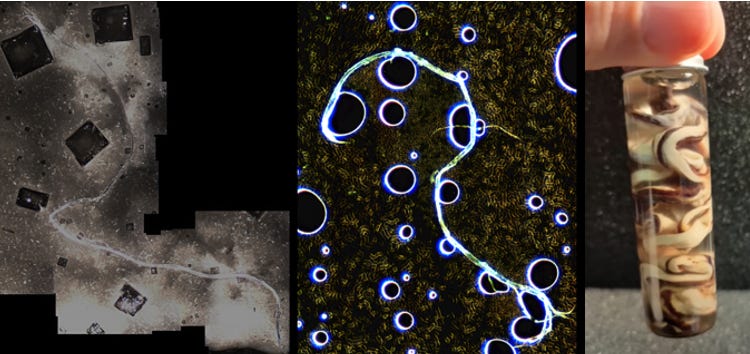
These questions arise naturally from observations made under the microscope. They are not restricted to dental anaesthetics, blood, saliva, urine, milk, or any other specific fluid. They belong to a broader class of phenomena in which organisation appears capable of increasing, persisting, and transforming across multiple scales.
Viewed in this way, the crystal itself may not be the most important feature of the sequence.
The more interesting question may be what the surrounding field is doing as the crystal appears to emerge, dissolve, contract, or expand. The crystal may represent only one visible component of a larger organisational transition occurring within the system.
This matters because the same question may also apply to the unusual white, rubbery casts that have been reported in some blood vessels after death. These structures are often discussed mainly as a question of composition: what are they made of? But if biological fluids can move through organised transitions that are not adequately captured by simple accumulation, dissolution, or precipitation, then the cast is not only a compositional problem. It is also an organisational problem.
If that possibility is real, then perhaps the most important question is not what the crystal is made of. Perhaps the more fundamental question is what kinds of organisational transitions biological materials are capable of undergoing.
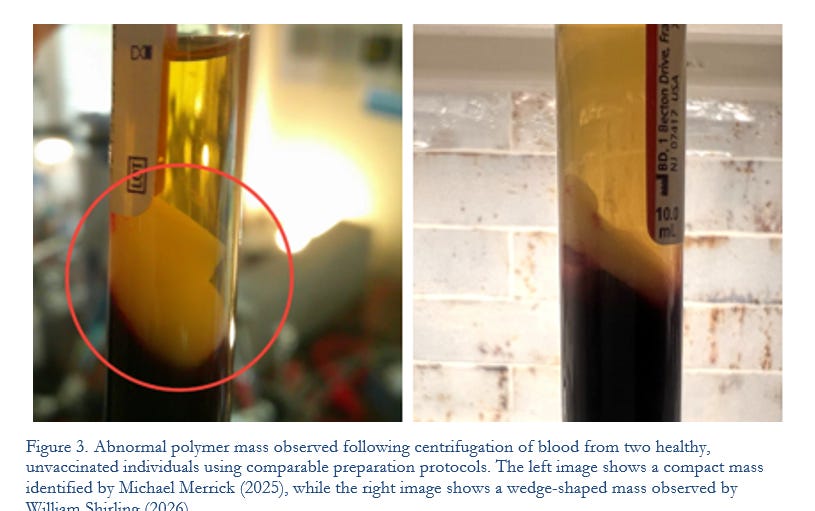
The reason this question matters extends far beyond a single microscope video. In recent years, a number of unusual biological structures have been reported across very different observational domains. Pathologists have described persistent proteinaceous clot material. Independent researchers have documented what Michael Merrick termed abnormal polymer mass within centrifuged blood preparations. Embalmers and investigators have reported large rubbery vascular casts occupying the lumen of blood vessels. Rapley and Shelton have more recently referred to them as anomalous intravascular casts (AICs).
At first glance, these observations appear unrelated. One occurs under a microscope. Another appears in a centrifuge tube.
A third is recovered from the vascular system itself.
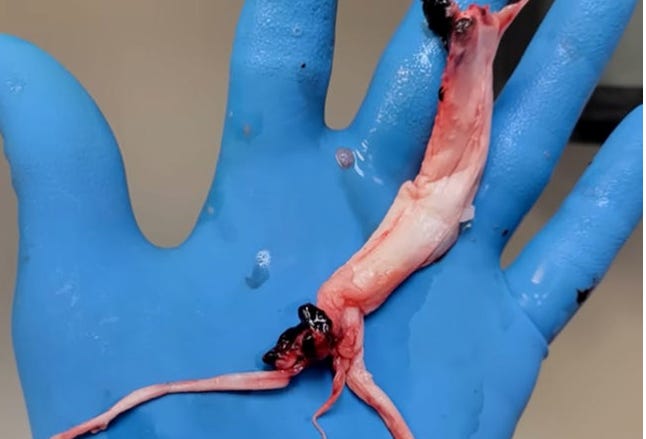
(Photo courtesy of Richard Hirschmann)
The usual scientific response is to ask what each structure is made of. Composition is important, but composition may not be the only question. The crystal video invites a different question.
What if the critical observation is not the material itself, but the transition between material states? Consider the abnormal polymer mass observed after centrifugation. The striking feature is not simply the presence of unusual material within the tube. The more interesting question is how a previously unremarkable blood sample came to occupy a new organisational state. Something has changed within the system. The material has reorganised.
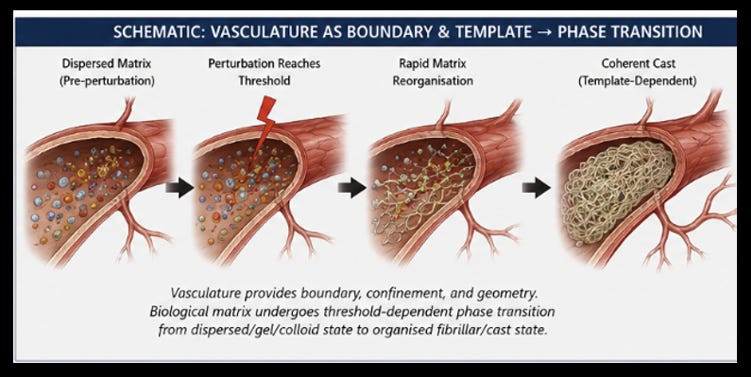
The same question can be asked of the vascular casts. The conventional image is often one of gradual accumulation. Small structures become larger structures. Material slowly builds until a cast is produced. Yet the morphology of many casts raises another possibility. They frequently occupy pre-existing vascular geometry with a coherence that appears disproportionate to a simple model of linear growth.
The vessel itself appears to act as a template.
The final structure reflects not merely the addition of material, but the organisation of material within a confined space. This is precisely the possibility explored in the soft-matter framework presented in From Micro to Macro. The central proposal is not that fibres grow directly into casts.
Rather, it is that biological materials may sometimes undergo threshold-dependent organisational transitions, moving from one material state into another under particular boundary conditions. Viewed in this way, the crystal, the abnormal polymer mass, and the vascular cast cease to be isolated observations. They become different expressions of the same underlying question.
What kinds of organisational transitions are biological materials capable of undergoing?
Readers interested in the broader framework behind these ideas can explore From Micro to Macro: A Soft-Matter Framework for Fibre Formation and Anomalous Intravascular Casts, available on my website here
The paper focuses on a specific question: whether unusual fibres, abnormal polymer mass, and vascular casts might be approached through the language of soft matter, phase behaviour, and organisational transition.
The broader context is developed in The Body as Soft-Matter.
Rather than focusing on a single structure or pathology, the book explores a more fundamental proposition: that biological organisation may be as important as biological composition. Blood, mucus, extracellular matrix, repair processes, inflammation, disease, and recovery can all be viewed through the behaviour of soft-matter systems operating under changing boundary conditions.
The aim is not to replace conventional biology, but to add another layer of description. Soft-matter physics provides a language for discussing emergence, phase transition, metastability, boundary effects, organisation, persistence, and transformation. These concepts are familiar in many areas of physics and materials science, yet they remain underused in discussions of living systems.
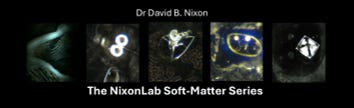
For readers interested in direct observation, the framework is accompanied by the Atlas of Soft-Matter Structures series. These atlases present hundreds of images collected using dark field microscopy across blood, biological fluids, evaporation studies, crystalline domains, fibres, gels, vesicles, colloids, and phase transitions. The emphasis is placed on observation first, interpretation second.
Together, the book and atlases invite a simple question.
If biological materials are capable of far richer organisational behaviour than we currently recognise, what might become visible once we begin looking for organisation as carefully as we look for composition?
Thank you to those that continue to support my work.
David


It is hard to keep sane witnessing all the demonic implications. Thank you for keeping a balanced scientific mindset to help us overcome this transformation. Surrounding you with love and light!
Brilliant, and obvious now that you've creatively brought it up. More is going on than first observational phenomenon presents. Environment! So complex are the variables, its easy to be reductionist in the observations. Many thanks
Sending love dear Dr.