
Three Years Later: Remembering Arne Burkhardt
And Observation Still Stands

Three years ago, today in Australia, and tomorrow in the United States, Professor Arne Burkhardt died.
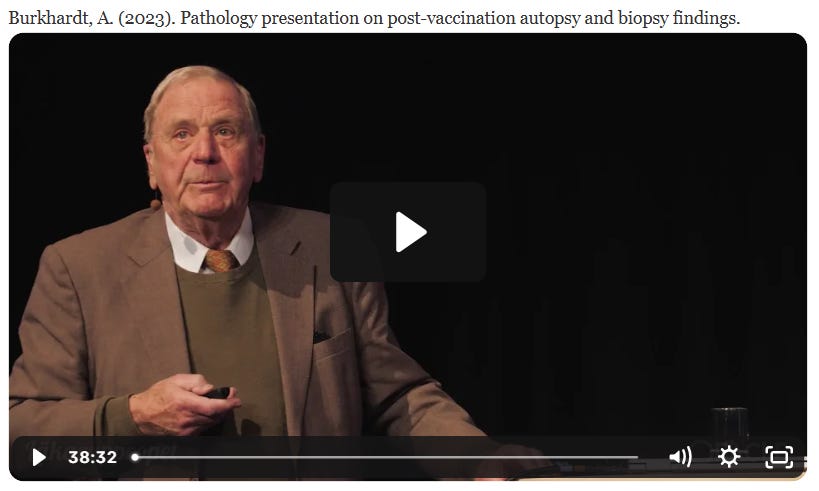
This is a frame grab from a video of a talk given at a conference in Iceland in early 2023. It may have been one of his last public talks. I have put it on my website here.
During the final years of his life, Burkhardt became known to many people for a series of pathological investigations that examined unusual tissue findings, vascular changes, inflammatory patterns, and persistent clot-like material. His work attracted both attention and criticism. Yet whatever position one takes regarding his interpretations, there is a more fundamental point that deserves reflection.
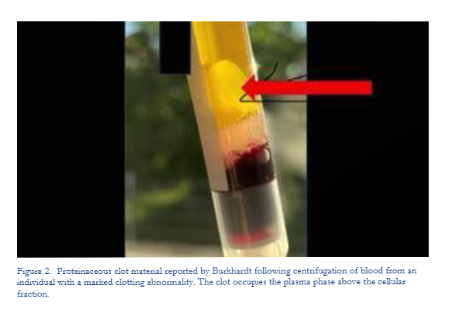
The observations remain.
Science often presents itself as a sequence of conclusions. Textbooks are filled with established facts, accepted mechanisms, and settled explanations. Yet scientific understanding rarely begins there. It begins with observation. Someone sees something unexpected. A pattern appears. A finding refuses to fit comfortably within existing categories. Only later do explanations emerge, and sometimes those explanations change repeatedly over time.
Observation comes first.
That is one reason why Burkhardt’s work remains important. His legacy is not simply a collection of conclusions. It is a collection of observations that entered the scientific record.
Whether every interpretation ultimately proves correct is not the central issue. History is filled with examples where the initial explanation changed while the underlying observation remained valid. What matters is that unusual findings were documented, photographed, discussed, and preserved. Once observations disappear, the opportunity for future understanding disappears with them.
Over the past several months I have spent considerable time revisiting Burkhardt’s work alongside a wider body of literature involving blood microscopy, proteomics, vascular pathology, fibrinolysis, extracellular matrix biology, and soft matter systems. One lesson has become increasingly clear.
The most productive question is often not, “What should I believe?”
The more useful question is, “What was observed?”
That distinction matters because belief tends to divide people into camps, while observation provides a common starting point. Different investigators may disagree about mechanisms, significance, prevalence, causation, or interpretation. Yet meaningful discussion can only occur if the observations themselves remain available for examination.
This principle extends well beyond Burkhardt’s work. Across medicine, biology, and science more broadly, there are many examples of observations that arrived before adequate explanatory frameworks existed. Some were eventually discarded. Some were reinterpreted. Some became foundational. The challenge is that these outcomes are not always obvious at the moment the observation is made.
For this reason, I have increasingly come to view the preservation of observational records as an important scientific responsibility. Images, videos, pathology reports, laboratory findings, and descriptive accounts all form part of a larger archive from which future understanding may emerge. Explanations evolve. Observations endure.
I am not publishing the full paper today. It is still with colleagues for comment, and I want to give that process the time it deserves. However, I have placed the relevant source material, transcripts, videos, and references on the NixonLab website here so that readers can begin examining the observational record for themselves. On this anniversary, that seems the most appropriate first step: not to close the argument, but to keep the observations available.
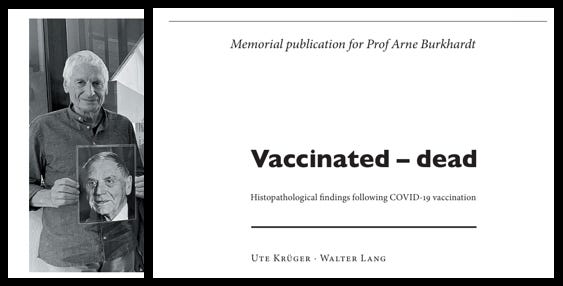
Readers interested in Burkhardt's work may also wish to be aware of the recently published memorial volume Vaccinated – Dead: Histopathological Findings Following COVID-19 Vaccination by Ute Krüger and Walter Lang. The volume was published in memory of Professor Arne Burkhardt and documents many of the pathological findings that occupied his final years. My own copy is currently in transit, and I look forward to studying it in detail. Professor Walter Lang is holding the photo of Dr Burkhardt below.
Three years after his death, Burkhardt’s work continues to occupy an unusual position. It remains controversial in some circles, neglected in others, and largely absent from mainstream discussion. Yet the material itself still exists. The photographs remain. The pathology slides remain. The transcripts remain. The observations remain. The questions remain.
And perhaps that is the most fitting way to remember him. Not as a figure who claimed to possess every answer. But as a pathologist who continued to look.
Three years later, the observations remain before us.
What we choose to do with them is now our responsibility.
Rest in peace, Professor Burkhardt.
The observations remain.
And, the Pfizer trial documents, observational stated all 9 pages of severe adverse effects.
Still amazes me how observational factors surrounding the “so called vaccines” are staring one in the face and they still choose to believe the propaganda !!!