
This Changes Everything: Real-Time Capture of Synthetic Assembly in dental anaesthetic:
Vesicles become rods. Rods become crystals. Crystals become complex. Programming confirmed.

This is it.
No matter how you look at it—chemically, structurally, or logically—this 30-second sequence changes the game.
What you're seeing is not random diffusion. Not artifact. Not classical crystallization.
A vesicle transforms into a rod.
It does so with directionality, coherence, and speed.
There’s no external trigger. No observable environmental shift.
It simply… happens.Captured live under phase contrast at 40x magnification, this single event reveals a dynamic, intentional behavior embedded in the material. Once seen, it cannot be unseen—and it cannot be dismissed.
Micronaut Precision: Will’s Lens on Dental Anaesthetics
It’s been another intense week. One of the clear highlights has been integrating high-resolution microscopy from the Micronaut team into my upcoming paper on self-assembling structures in dental anaesthetics. These aren’t just images—they’re evidence.
Today, I want to spotlight the extraordinary work of Will, whose patient, methodical observation has revealed one of the most striking phenomena we’ve encountered: vesicles transforming into rods, which then act as nucleation points for black crystalline assemblies.
Captured under phase contrast at 40x magnification, Will’s footage documents this transformation in real-time. The coherence, speed, and structural intention defy conventional assumptions about passive pharmaceutical residues. His images—taken with a standard microscope, outside any institutional lab—demonstrate that what we’re witnessing is not only real, but reproducible, and deeply significant.
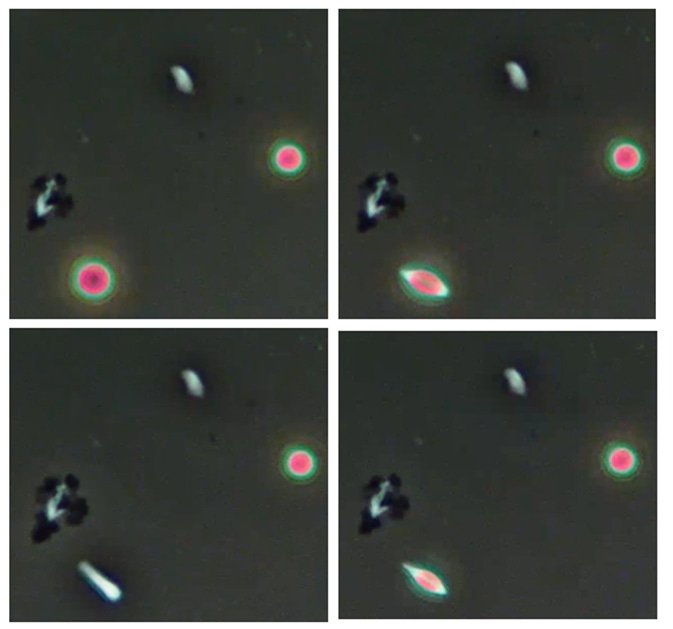
In this four-frame sequence, a vesicle-like structure elongates into a rigid, rod-like form.
It begins as a compact sphere and transforms—progressively, without any external stimulus—suggesting an internal instruction set or embedded phase-shift logic. Spatial orientation is preserved. Coherence is maintained. This is not residue behavior. This is stepwise programming.The vesicle-to-rod transformation marks the first stage in a cascade:
Vesicles → Rods → Crystals.
The vesicle-to-rod transformation marks the first stage in a cascade. Rods emerge from blobs. Then, crystals emerge from rods.
Watch what happens.
In the video embedded below, a vesicle begins to elongate—quietly, purposefully—into a rigid rod.
No visible driver. No mechanical force. Just logic, unfolding in plain sight.This isn’t a one-off.
In the broader field of view, multiple vesicles are seen in various stages of transformation.
Red arrows mark two vesicles whose full transformations into rods were captured on video.
The green arrow points to another vesicle mid-transition—already elongating.
Together, these form a clear, observable progression.
Rods consistently act as crystallization axes.
Around them, black geometric structures form—predictably, reproducibly, and with precision.
In a follow-up sequence, paired images taken one minute apart show a vesicle adjacent to a developing rod before and after crystallization. The rod appears first. The crystal forms around it.
The implication is clear: rods initiate.
They don’t just exist—they direct.The resulting structure—a black geometric crystal—is anchored to the original rod.
This is not passive accumulation. This is stepwise construction:
Vesicle → Rod → Crystal.
Each phase has a defined role. The logic is embedded.
In a close-up of a fully formed black crystal, the embedded rod is unmistakable.
It sits at the center—not as noise, but as structure.
It appears intentional. Anchored. Aligned.This supports the hypothesis that vesicle-derived rods serve as nucleation sites, providing directional cues or templating frameworks. Their consistent presence across samples strengthens the case that we are not observing stochastic behavior, but rather synthetic self-assembly.

But it doesn’t stop there.
Once the crystal forms, vesicles continue to interact with it.
In this stained image from Seth, vesicles cluster at strategic positions around the crystal’s internal boundaries.They’re not bystanders. They’re shaping. Delivering. Sculpting.
This supports a model of ongoing programming—not a one-time formation event, but a recursive material evolution guided by vesicles and structural logic.
Vesicles Are Born in the Droplet
They don’t appear from nowhere.
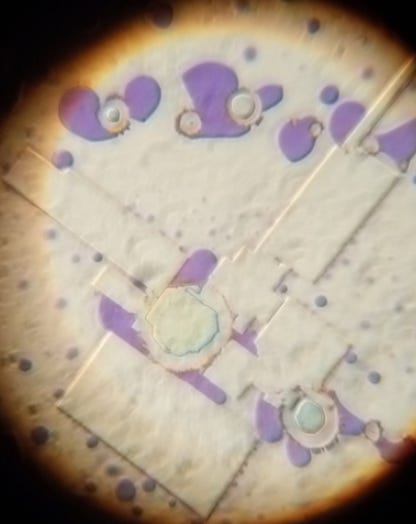
These next images show how Sessile Droplet Evaporation (SDE) is itself a vesicle engine—a microscopic mixer and nano-organizer.
Under phase contrast (Will), vesicle chains form along discrete boundaries—suggesting electrostatic patterning or templating logic.

Under dark field (my own), the process looks more chaotic—yet equally structured—with vesicle-like bubbles clustering around emerging crystalline or gel phases.

The conclusion:
SDE is a nanofactory.
This is where nano becomes micro.Then Will Discovered Even More
Two additional findings reinforce that we’re not looking at residue.
We’re looking at engineered material behavior.1. Crystals That Bend
At 100x magnification, large rectangular crystals can be seen flexing—without fracture.
No cracks.
No splintering.
Optical coherence preserved

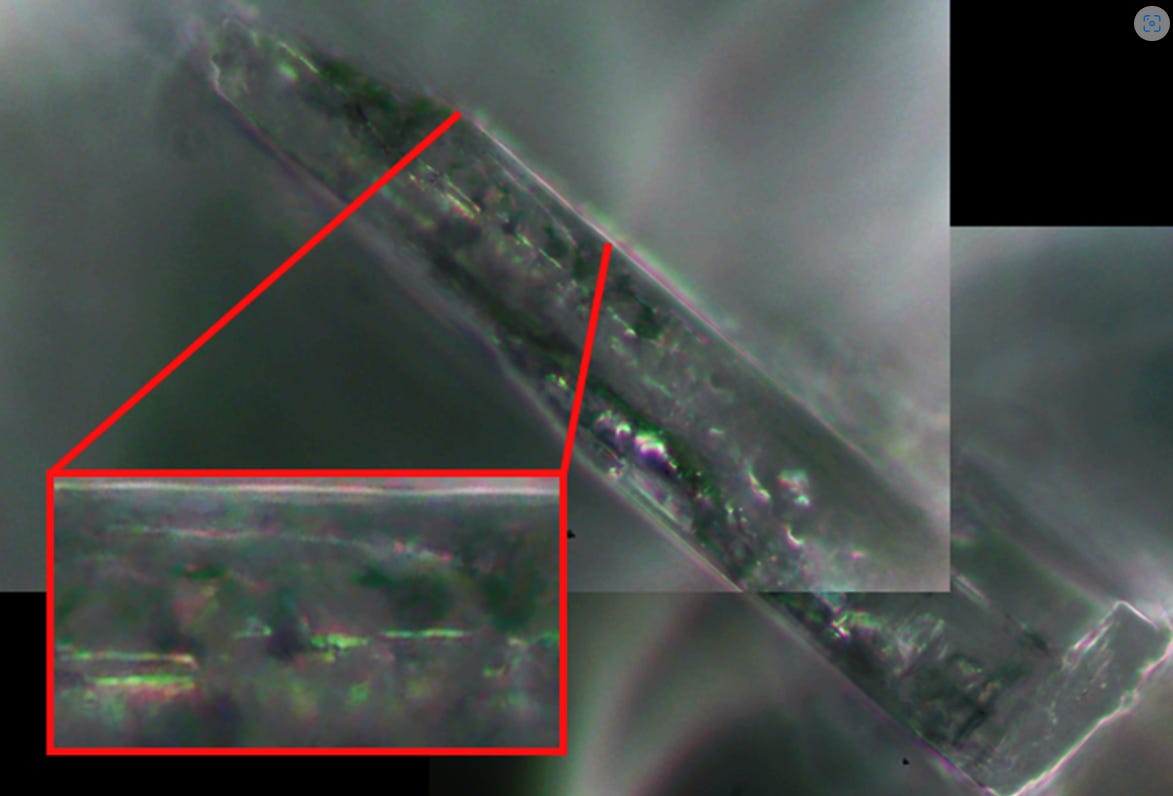
Three-phase transition of a rectangular crystal structure showing progressive internal complexity. Inset: High-power magnification of the upper central zone reveals periodic folding behavior—supporting dynamic internal patterning consistent with synthetic design.
Sequential phase contrast images show bending over time.
The structure remains intact—suggesting hydrogel composition or flexural design properties.
This doesn’t happen with salts.2. Crystals That Are Layered
At higher magnification, internal layering is clearly visible.
These are not single-phase monocrystals.
These are modular constructs—assembled in layers.A crystal standing on edge, imaged at ~100x with phase contrast/dark field, reveals visible laminar stratification throughout the vertical axis.
This resonates strongly with Zang et al. (2025), who showed that non-classical crystallization in binary colloids can produce:
Hollow-core crystals
Layered architectures
Hierarchical growth from nanoscale to macroscale
What Zang modeled in controlled labs, we are now witnessing inside dental anaesthetics, under basic microscopy.
This is not salt.
Not cholesterol.
Not sugar.
Not natural.This is programmed architecture—built from pharmaceutical components using unknown catalysts and internal logic.
It is reproducible, structurally coherent, and functionally mysterious.It appears across products, samples, and researchers.
Nixon’s Triad
Will’s sequence provides the clearest visual confirmation yet of what I’ve termed Nixon’s Triad:
Vesicles
Colloids
Complex morphologies (e.g. CRMs, CFAs) see www.drdavidnixon.com Pfizer paper for more details.


This triad appears across formulations, manufacturers, and imaging conditions.
Once again, we’re not seeing random residue.
We’re seeing intention.
Vesicles become rods.
Rods become crystals.
Crystals become complex.
Programming confirmed.
Thank you to all my subscribers. I am grateful for support in whatever form it comes.
I hope your weekend goes well.
—David
PS: Zang et al. (2025), Nature Communications: https://doi.org/10.1038/s41467-025-58959-0

